Hattie Walters

Hattie Walters

PhD Candidate, Department of English Literature, University of Birmingham

hxw368@student.bham.ac.uk

My work discusses interactions between the garden and literary and visual cultures in the late-nineteenth and early-twentieth centuries, with an emphasis on the materialisation of lived and local histories through garden work.

From Gertrude Jekyll, Mary Watts, and Ford Madox Ford, to the Sitwells, Dora Carrington, Sylvia Townsend Warner, and Vita Sackville-West, I am fascinated by how an individual’s gardening influences (and interferes) with their artistic practices—and how they engage with an artistically mediated understanding of rural countryside.

I look to unpick how gardens, broadly defined, can be exploited not just as an inseparable stimulus for a figure’s art but molded to provide a personal interrogation into history, frequently one localised and set on invigorating an ideal of the rural working class. The study of modern garden cultures enables the isolation and examination of the material interventions of artistic cultures into rural life, from the reclamation of historic houses, to the beautification of derelict cottages, and the cultivation of horticultural “quaintness”, or a pre-existing sense of “charm”.

I am particularly interested in tracking a personal kind of garden history: revelations amongst runner beans, for instance, or biographically endowed potato plants; the design of terracotta pots in a declaration of family heritage; formative readings in orchards; or queer country cottage retreats.

Wordsworth’s art of place

In the year of Wordsworth’s 250th birthday, Jessica Fay shows how Wordsworth responded to the craze for picturesque garden ruins and his affirmation of the slower, quieter stories of lives and places that ruins can evoke.
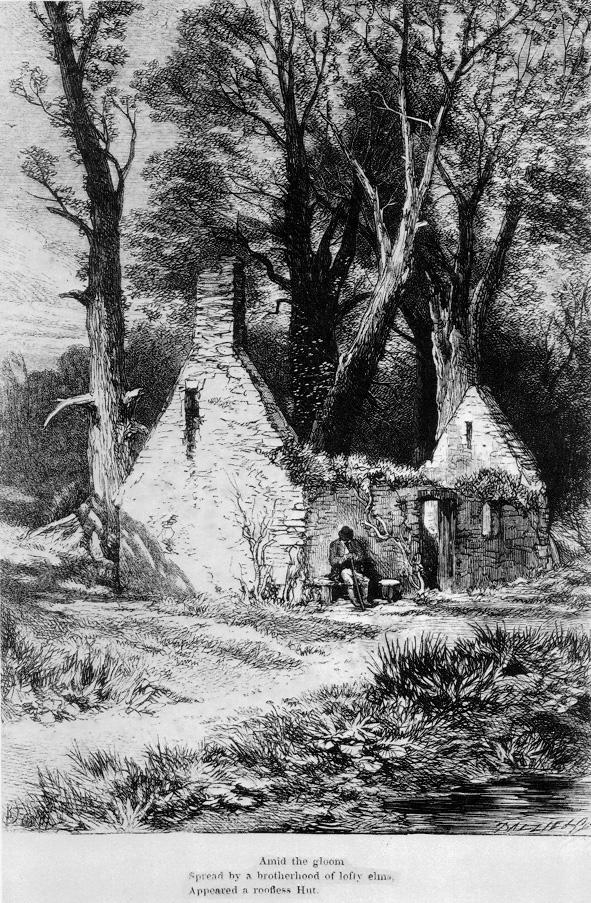
Myles Birket Foster’s frontispiece to William Wordsworth, The Deserted Cottage (1859) engraved by the Brothers Dalziel.

Myles Birket Foster’s frontispiece to William Wordsworth, The Deserted Cottage (1859) engraved by the Brothers Dalziel.

Imagining William and Dorothy Wordsworth out walking in the Lake District might involve thinking of them closely observing their surroundings, commenting on what they notice, talking about local news or Napoleon’s most recent campaign, or reciting poetry. We might imagine them pausing to refresh themselves with cold beef or leftover gooseberry pie that they carried in their pockets. But we might not think of them pausing to take out a tinted Claude Glass.

The fashionable activity of ‘picturesque tourism’, made popular by William Gilpin’s guidebooks of the 1780s and 90s, involved observing natural scenery through a small glass mirror or an imaginative filter. The mild absurdity of this practice of re-tinting and rearranging what was actually visible in a landscape is emphasized by a quip of Jane Austen’s in Northanger Abbey (composed 1798–99), where Henry and Isabella Tilney view ‘the country with the eyes of persons accustomed to drawing’ and proceed to decide its ‘capability of being formed into pictures’ (with a pun on the nickname of fashionable landscape gardener Lancelot “Capability” Brown). The heroine, Catherine Morland, is considered ironically to be without ‘natural taste’ until she’s been instructed in picturesque principles.

Wordsworth intimates his opposition to the picturesque in Book XI of The Prelude (1805), where he describes the habit of looking at nature through the lens of art as ‘a strong infection of the age’. He objected to landscape appreciation in which ‘the eye [is] master of the heart’ and where insufficient attention is paid to ‘the moods | Of nature, and the spirit of place’. Although Gilpin and his followers recognised the importance of felt responses to scenery, picturesque tourism seemed (to the poet) to commodify nature. But the Wordsworths did own a Claude Glass and William’s engagement with the picturesque—as a gardener as well as a poet—was deep and considered.

In his Guide through the District of the Lakes (first published in 1810), Wordsworth sets out a key principle for gardening: ‘The rule is simple; with respect to grounds—work, where you can, in the spirit of nature, with an invisible hand of art’. This might appear to be an endorsement for the style of gardening initiated by William Kent at Stow in the 1730s, which helped catalyse the craze for all things ‘picturesque’. Kent’s invention of the ha-ha (or sunken fence) made it possible to conceal boundaries between a cultivated garden and the landscape beyond. In Kent’s sweeping open prospects, the ‘hand of art’ was far less visible than it had been when parterres and topiary were the order of the day. Yet Wordsworth agreed with gardeners such as Uvedale Price (whose Essay on the Picturesque was first published in 1794) that the conventions established by Kent, Brown, and their followers came to be applied too mechanically. Since features such as serpentine lakes, trees arranged in clumps or belts, temples, hermitages, or follies were so recognisable, the artifice of landscape gardening was in fact obvious. Disregarding the idiosyncrasies of a given place, these “improvers” often overlooked ‘the spirit of nature’.

A 19th century Claude Glass, or Black MirrorIn particular, Wordsworth agreed with Price that ‘improvers’ paid too little attention to timeworn characteristics such as ancient trees and dilapidated stonework. But Wordsworth and Price appreciated these rugged features for different reasons. For Price, any object is picturesque if it bears three specific visual qualities: roughness, sudden variation, and irregularity. Ruins of different kinds—the remains of once-consecrated monasteries, crumbling manor houses, mouldy humble cottages, or even purpose-made follies—are equally admirable when they exhibit these qualities. Wordsworth, by contrast, didn’t primarily value ruins for their surface appearance: he was less interested in form and texture and more concerned with the personal or communal histories attached to these objects. The ruins of medieval monasteries such as Tintern, Furness, and Bolton, were important as loci of regional heritage; the ruins of secular dwelling places similarly offered, for Wordsworth, means of connection with previous inhabitants through an experience of place. Importing faux ruins or follies into gardens as picturesque props—and for the sake of fashion—bypassed any such place-centred human connection.

An entry in Dorothy’s Alfoxden journal from April 1798 provides an example of what the siblings considered a misuse of garden-ruins. Dorothy describes a visit to Crowcombe Court in the Quantocks where she explored a garden laid out by John Bernard (son-in-law of the owner Thomas Carew) in the 1770s:

A fine cloudy morning. Walked about the squire’s grounds. Quaint waterfalls about, where Nature was very successfully striving to make beautiful what art had deformed—ruins, hermitages, &c., &c. In spite of all these things, the dell romantic and beautiful, though everywhere planted with unnaturalised trees. Happily we cannot shape the huge hills, or carve out the valleys according to our fancy.

The ruins at Crowcombe were fifteenth-century fragments of stone arches transplanted from nearby Halsway Manor, perhaps arranged to evoke contemplation or melancholy, or to give the Court (built in 1725) an air of antiquity. When Dorothy complains that Bernard has deformed nature, she recognizes that the ruins don’t belong there and is thankful that nature is visibly pushing back against the interfering ‘hand of art’.

A more complex example of nature counteracting cultivation is worked out in Wordsworth’s The Ruined Cottage. First composed at Alfoxden in 1797, the poem underwent several stages of revision before being published as the first book of The Excursion (1814). If it had appeared under its original title at the end of the 1790s, however, that title would have raised specific expectations. For readers well-acquainted with picturesque aesthetics, The Ruined Cottage promises riches: perhaps the poem will focus on quaint ruins like those commonly found in landscape paintings or used as garden ornaments? The opening lines, which describe the effect of ‘steady beams’ of sunshine on an expansive landscape, might also have encouraged readers to think they’d embarked on a conventional eighteenth-century prospect poem. But Wordsworth quickly subverts, or rather deepens, these expectations. As the cottage and its garden are placed in the context of the suffering of their inhabitants, the poem becomes a critique of purely visual, surface appreciation of ruins.

The Ruined Cottage narrates a meeting between a Poet and a Pedlar beside the dilapidated cottage of a woman named Margaret. As they look at the ruin, the Pedlar explains Margaret’s history. Following failed harvests, illness, and loss of work Margaret’s husband, Robert, was forced to enlist. She was left alone with two children and became increasingly despondent as she failed to discover news of Robert’s whereabouts or welfare. Under the weight of poverty, desolation, and loneliness, during a time of deprivation and war, Margaret neglected to take care of herself, her children, the cottage, and the garden. At length she was deprived of both children and of all hope that Robert would return; after five years of suffering, Margaret died.

At the start of the poem, the Pedlar and the Poet survey the deserted cottage and garden:

It was a plot
Of garden-ground, now wild, its matted weeds
Marked with the steps of those whom as they pass’d,
The goose-berry trees that shot in long lank slips,
Or currants hanging from their leafless stems
In scanty strings, had tempted to o’erleap
The broken wall. Within that cheerless spot,
Where two tall hedgerows of thick willow boughs
Joined in a damp cold nook, I found a well
Half-choked [with willow flowers and weeds.]
I slaked my thirst and to the shady bench
Returned, and while I stood unbonneted
To catch the motion of the cooler air
The old Man said, “I see around me here
Things which you cannot see: we die, my Friend,
Nor we alone, but that which each man loved
And prized in his peculiar nook of earth
Dies with him or is changed, and very soon
Even of the good is no memorial left. (ll. 54–72)

At Crowcombe, Bernard’s ruin was installed and positioned for picturesque effect; through later neglect, nature began to counteract the ‘fancy’ of the gardener, and this pleased Dorothy. In The Ruined Cottage, however, any assessment of nature’s reclamation of Margaret’s garden is more complicated. From the Poet’s perspective, this is a scene of deprivation: the garden wall has fallen down, the well is ‘half-choked’ by weeds, the gooseberry bushes are ‘lank’, strings of currants are ‘scanty’; it’s a ‘cheerless spot’ and there are implications of sinfulness and corruption in images of temptation, trespass, and forbidden fruit. The Poet (keen to find compelling material to write about) is inclined to indulge in the melancholy atmosphere. Yet the Pedlar sees things differently.

One reason why the Poet doesn’t see what the Pedlar sees is that, at this point, he hasn’t heard Margaret’s story. As the poem progresses, the Pedlar peels back layers of time and memory, revealing how the stages of Margaret’s emotional deterioration contributed to the development of the ruin. By the end of the poem, the tumbledown cottage and overgrown garden bespeak Margaret’s decline, and thus the Poet’s perception is changed: he doesn’t now appreciate the ruins for their picturesque form and texture (as Uvedale Price might have done) but rather for their human context. As Dorothy noted at Crowcombe, ruins are not moving in themselves; but the ruined cottage has a profound emotional effect on the Poet when history, imagination, and empathy are added to his visual experience.

The poem concludes, however, with the Pedlar asking the Poet not to indulge in the sadness of the scene but to walk away in calm happiness:

“My Friend, enough to sorrow have you given,
The purposes of wisdom ask no more;
Be wise and cheerful, and no longer read
The forms of things with an unworthy eye.
She sleeps in the calm earth, and peace is here.
I well remember that those very plumes,
Those weeds, and the high spear-grass on that wall,
By mist and silent rain-drops silver’d o’er,
As once I passed did to my heart convey
So still an image of tranquillity,
So calm and still, and looked so beautiful
Amid the uneasy thoughts which filled my mind,
That what we feel of sorrow and despair
From ruin and from change, and all the grief
The passing shews of being leave behind,
Appeared an idle dream that could not live
Where meditation was. I turned away
And walked along my road in happiness”. (ll. 513–24)

Wordsworth’s thinking about picturesque aesthetics helps explain these moving, yet difficult, lines. One of the purposes of the poem is to teach the Poet to be serene in the face of suffering and change: the extra unstressed syllable at the end of the first line denotes the cusp of what is ‘enough’. Ruins make visible processes of decay but they also reveal nature’s regenerative powers. As Margaret finds ultimate harmony with—and within—the earth (‘She sleeps in the calm earth, and peace is here’), the pace of the verse slows. The Pedlar recognizes that the tranquillity of nature endures, whereas grief is alleviated by time. The survival of the spear-grass and the sustained life and beauty of the garden, channelled through memory and expressed within an elongated sentence that entwines visual with interior experience, provide lasting consolation. The Pedlar’s speech affirms that poetry, and the empathy it produces, helps readers to apprehend the significance beneath the surface; reading ‘the forms of things’ more worthily involves attending to art and nature with an eye that is not ‘master of the heart’. Visual apprehension is transformed when it is supplemented with an underlying sense of what a place has meant to—and what it says about—the people connected with it. Picturesque gardening that clears away knotted or uneven features produced by the slow passage of time (in favour of smooth man-made lines) lacks these submerged human resonances.

Looking through a Claude Glass is, in this way, a less worthy (that is to say, less poetic) mode of viewing. But, for Wordsworth, shaping nature into art has its benefits, too. While the Wordsworths’ Claude Glass may have helped them to reimagine the landscape in a moment (perhaps between bites of cold gooseberry pie), practical gardening works with nature to produce visual and emotional effects over time. ‘Laying out grounds’, William once explained, ‘is some sort like Poetry and Painting, and its object … [is] to assist Nature in moving the affections’. But, he continued, ‘If this be so when we merely put together words or colours, how much more ought the feeling to prevail when we are in the midst of the realities of things’. Gardening that balances the ‘spirit of nature’ with the ‘hand of art’ is itself a kind of poetry; or, we might say, an art of place.


Bethan Roberts

Bethan Roberts

Bethan Roberts

William Noble Postdoctoral Research Fellow, University of Liverpool

My first book: Charlotte Smith and the Sonnet: Place, Form and Tradition in the Late Eighteenth Century (Liverpool University Press, 2019) offers the first full-length study of Smith’s influential Elegiac Sonnets and clarifies its ‘place’ – in multiple ways – in literary history as a work celebrated for ‘making it new’, yet deeply engaged with the literary past. It argues that Smith’s sense of literary tradition is inscribed in the subjects of her poems, and that the literary associations of the places, settings, flora and fauna of her sonnets – across the River Arun, the sea, plants and flowers – are a constitutive aspect of them. It is interested in and reveals the complex processes underpinning Smith’s reception and paradoxical position from the late eighteenth century to the present day, and shows that the appropriation of place itself was an important way in which aspects of literary tradition have been negotiated and understood by Smith, her predecessors, contemporaries and successors. My second book is Nightingale for the Reaktion Press Animal series (forthcoming, 2021) and my current research is on Romantic ornithology; and on the literary and natural history of the River Mersey.

Jimmy Packham

Jimmy Packham

Jimmy Packham

Lecturer in North American Literature, University of Birmingham

My interests in landscape and environment flow in two (occasionally overlapping) directions: the literature of the sea and the blue humanities, on the one hand, and the gothic and the nonhuman, on the other. What unites these topics is how literature can speak to us on an ethical level – not how it can dictate certain morals to us, not how it might tell us how we can or how we should behave; but rather, how careful and considered engagement with a piece of writing, how listening to the voices and representational work within that piece of writing, provides the building blocks for understanding our own ethical relationship with others, and with the world we inhabit. By inflecting this process by the seascapes and environments, and nonhuman creatures (and monsters) of maritime and gothic fiction, we are challenged to engage with ideas, worlds, behaviours, forms of being that are at times wholly unfamiliar, alien to, hostile to, our usual terrestrial world and the modes of being and behaviour we are used to engaging in.

My recent research follows several trajectories with this literature: the cultural history of the deep sea, exploring how the deep and its ecosystems are often portrayed as being somehow “beyond” our limited human knowledge and asking what it means to cast a natural environment in these terms; the representation of human-animal relationships in recent gothic fiction about vegetarianism or meat production; and the role of the coast in gothic fiction from the eighteenth-century to the present, exploring the intersection of human culture and an environmental ecotone traditionally seen as “in-between”, neither sea nor land proper, neither here nor there.

Matthew Ward

Matthew Ward

Matthew Ward

Lecturer in Nineteenth-Century Literature, University of Birmingham

Matthew is interested in the art of place specifically from the perspective of soundscapes and listening to (primarily natural) environments. His background is in the history of emotions of the long eighteenth century and Romantic-period writing, and his fascination with our relation to, and feelings for, the natural world stems in part from the emergence during this time of what we might call an ecological way of thinking. Specifically, then, what we might say is a certain Romantic hope (perhaps most clearly articulated in the writing of the Wordsworths) that sympathy with nature leads also to greater understanding of ourselves and others.

Matthew’s next project will hopefully explore the sorts of thinking and feeling produced by listening to the sounds of the natural world, and how particular places (for instance riverbanks, seashores, forests, mountain-tops, open fields) might speak with distinctive resonance. He hopes that a consideration of listening in literature (and especially the response and attitude of Romantic and post-Romantic poets) to landscape, location, place, and space, will encourage us to be more attentive and attuned to the natural world. Listening in literature is also an invitation to become better listeners – both to literature and its sounds, rhymes and rhythms, its sonic effects and in our lives and how we listen to the environment and its ever-changing soundscape. During a time of ecological and environmental crisis, such possibilities lead to opportunities to better process how we listen to nature and what it is telling us about our fragile planet. Matthew is keen to explore how this project might have educational value as well – not only to inspire greater environmentalism but also to encourage children to spend more time outside as a way of helping them reflect on their place in the world, and how environments provide imaginative space as well.

Rona Cran

Rona Cran

Rona Cran

Senior Lecturer in Twentieth-Century American Literature and Director of the Centre for the Study of North America, University of Birmingham

My current book-in-progress, Everyday Rebellion: Poetry and Resistance in New York, 1960-1995, is a study of poetry and resistance from the counterculture to the AIDS crisis. The study of New York poets involves an intellectual and affective closeness with the spaces and places of the city: much of their work is framed or shaped by what Jane Jacobs called (‘the heart-of-the-day ballet’, the immediate and localised intensities of New York. And yet, as Megan Bradbury writes, ‘the city is not a work of art. It is not an object. It is not something to be admired from a distance – it is a process’. Everyday Rebellion explores this process, arguing that socially-situated poetry offers crucial sites of resistance. It asks what we can learn from a poetics of loitering, of being on the street, of making contact with people in contingent places rather than within institutions; it examines the ways in which New York poets negotiate conflicting perceptions or experiences within the city; it considers the significance of working within a definable urban community, such as the New York School or the Black Arts Movement, or without one; it ponders the changing nature of the city streets for women poets, queer poets, and poets of colour, thinking about what it means to move or not move around the city; it investigates the erasure of queer connections and the work that city poetry does to combat this, thinking about the importance of alternative mapping to queer work; and considers the ways in which the poetry accounts for, or fails to account for, the environment out of which it emerges, that ‘Byzantine City’, to borrow from Jed Perl, that ‘place of exchanges, of cross-fertilizations’.

Samantha Matthews

Samantha Matthews

Samantha Matthews

Senior Lecturer in English, University of Bristol

The site-specific character of writing and reading is central to my work in Romantic and Victorian literature, culture, and book history. Poetical Remains: Poets’ Graves, Bodies, and Books in the Nineteenth Century (OUP, 2004) analysed the burial places and commemorative topographies of poets – Burns, Hemans, Hood, Keats, the Rossettis, Shelley, Tennyson and Wordsworth – as resonant sites for critical reception and imaginative homage, via varied texts, images, and literary tourism. This interest in churchyards and cemeteries as complex sites and subjects which invite yet resist representation joins up with my fascination with material texts which directly address the reader and attempt to shape their experience. Album Verses and Romantic Literary Culture: Poetry, Manuscript, Print, 1780-1850 (OUP, 2020), which reconstructs the largely forgotten 1820s’ craze for keeping albums and collecting album verses, reconsiders Romantic manuscript and print culture in relation to places and personalities. It reconstructs lost albums and visitors’ books associated with specific buildings and landscapes (the ‘Album of the Fathers’ at the Monastery of the Grande Chartreuse, the Jerningham family album at Cossey Hall, Norfolk) and reads album verses and inscriptions as site-specific and temporally located unique autographic texts which were appropriated, discredited, yet disseminated in commercial print culture.

Will Bateman

Will Bateman

William Bateman

PhD Candidate, Department of English Literature, University of Birmingham

Sitting in the gardens of San Gaudenzio, above Lake Garda, D. H Lawrence reflected of the spirit of place, ‘Does it pass away, or does it only lose its pristine quality? It deepens and intensifies, like experience’. In the perplexity of this reflection, Lawrence captures the curious contradictions which permeate his intense depictions of places and their populations. It is in this context that my research attends to the significance of place for both literary impressionism and modernism.

My current project explores Lawrence’s impressionistic responses to landscape and place in his writings on travel. Reading Lawrence’s travel sketches from the perspective of literary impressionism, it seeks to understand how a writer might codify and express the ambiguous and subjective nature of place. Exploring relevant ideas of otherness and alterity, it goes on to explore how we can read the indecipherability of place through the compositional history of texts. Finally, through an examination of Lawrence’s writings on Etruscan archaeology, it explores the significance of Ambivalence as a narrative strategy for ‘working-out’ the stratified layers of place.

Accordingly, my research engages actively with ideas of home, alterity, self-exile, and landscape. In addition, I am interested in how the narrativization and fictionalisation of ‘place’ and ‘emplacement’ contributes to resurgences in popular nationalistic feeling.

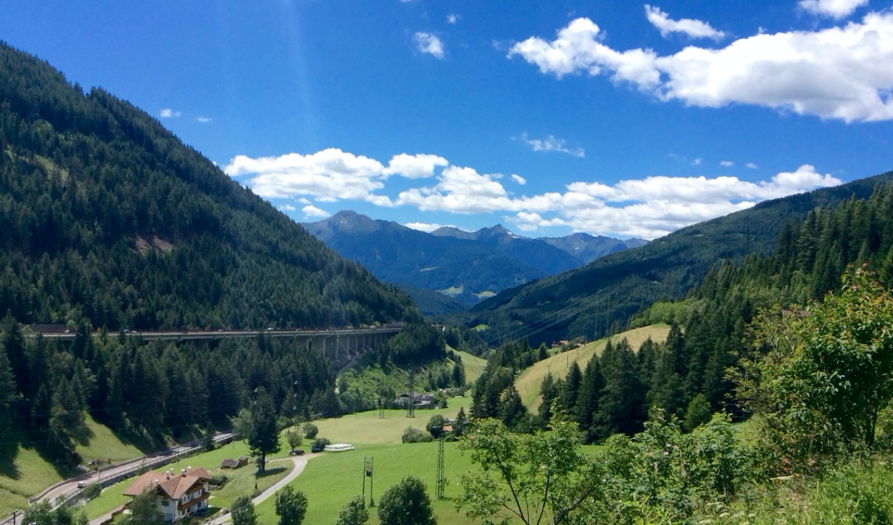
A glimpse of the Brenner Pass

The Brenner Pass represented a significant point of transition for D. H. Lawrence – both geographically and culturally. The ancient imperial road, the Via Imperii, once crossed the border between Austria and Italy at the Brenner, and for Lawrence the mountain pass marked the divide between industrialised northern Europe and the sensuous south. As part of my current research, I am reflecting on the significance of border crossing and mobility in the landscapes of Lawrence’s travel writing. Lawrence’s journey across the Alps to Italy, described in Twilight in Italy (1916), juxtaposes strange ‘atmospheres’ with moments of startling cognition – a contrast which highlights his intense interest in the literary investigation of perception and expression. Making comparisons with the ontology of literary impressionism, and in particular the writings of Ford Madox Ford, my research explores how Lawrence combined evocative depictions of place with metaphors of mobility, estranging landscapes, and invoking otherness in order to reproduce and comprehend his own bewildered impression of modernity.  

Christopher Donaldson

Christopher Donaldson

Christopher Donaldson

Senior Lecturer in Cultural History, University of Lancaster


Modern landscape history is my main area of research.  My interest in this subject is threefold.  I am particularly interested in investigating how historical perceptions of places can help us recontextualise the administrative realities that condition our experiences of those places in the present. 

I am, moreover, interested in how geographically informed research in the environmental humanities can create new knowledge for the environmental sciences. 

Finally, I am interested in how geographical methodologies can create new perspectives and possibilities for humanities scholarship, especially in disciplines that are organised in terms of linguistic and temporal divisions. 

These interests are reflected in my current research projects.  The first of these focuses on the history of the Lake District’s designation as a National Park between the eighteenth century and the twentieth century.  The second project builds on my previous work in the digital humanities and involves the use of computational methodologies to develop a historical knowledge base about past environmental conditions in globally significant upland regions. Both projects build on my recent publications.

Lauren Working

Lauren Working

Lauren Working

Postdoctoral Researcher, TIDE, English Faculty, University of Oxford

lauren.working@ell.ox.ac.uk

My research focuses on early modern politics, taste, and empire. It seeks to reconstruct Anglo-Indigenous relations using texts, plantation archaeology, and museum collections, including portraits at the London National Portrait Gallery and South American featherwork at the Pitt Rivers Museum in Oxford. My book, The Making of an Imperial Polity: Civility and America in the Jacobean Metropolis (Cambridge University Press, 2020), explores the entanglement between Native American lifeways and political culture in London, arguing that the civil identities of the governing elite became bound up in colonial intervention and the cultivation of American spaces. Related to this, I am interested in how American commodities and artefacts – tobacco leaves, beaver furs, shell beads – left their places of origin and were appropriated in new contexts in London. I am currently working on an article on how cavalier poets and artists imagined Madagascar in the 1630s; and another on early Stuart plantation landscapes and their connections to English estates and pleasure grounds. An ongoing element of my research is about heritage and how we confront the legacies of colonialism in country houses, plantation sites, and museum displays, including the place of contemporary art and poetry in ‘speaking back’ to historical material.

More on the TIDE Project