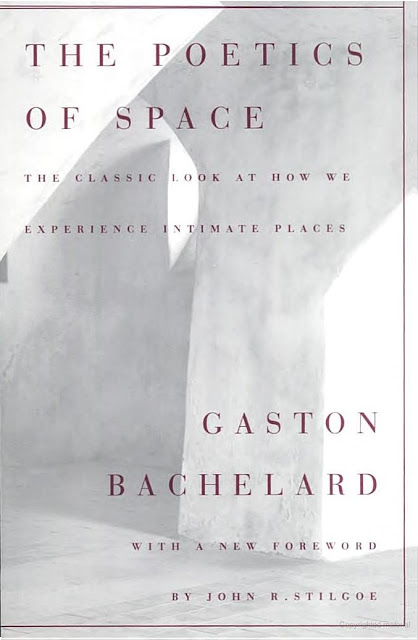
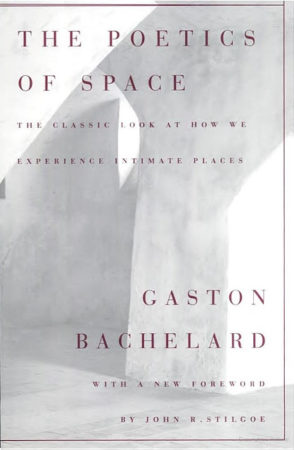
The Poetics of Space

Gaston Bachelard (1958)

Recommended by Trish Halligan

This book is difficult to categorise but this is where, to me, the joy of it dwells. In describing the domestic spaces that both give us shelter and provide an untrammelled place in which to think and feel, Bachelard explores poetry, philosophy, observation and memory (sometimes simultaneously). He offers reflections on drawers, chests, nests, wardrobes and corners; there is also a seemingly contradictory but completely revelatory chapter on what Bachelard terms ‘intimate immensity’.

I especially love this latter chapter and the one on corners. Somehow I never realised that I most comfortably read, think and work in the shelter of a corner, either a naturally occurring one or one I have managed to construct. Bachelard removes entirely the negative connotation of being “cornered” and in these chapters beautifully aligns the absence of claustrophobic thinking with its opposite of being present in vast exterior spaces: on the sea or in forests. It summons to my mind Woolf’s recognition of the need for the ‘queer amalgamation of dream and reality, the perpetual marriage of granite and rainbow’.

‘Housed everywhere but nowhere shut in’, writes Bachelard, ‘is the motto of the dreamer of dwellings… A daydream of elsewhere should be left open therefore, at all times’. This also puts one in mind of anchoresses or of William Cowper in his beloved alcove at Olney. In both cases their bodies are sheltered by a small space and their external vision is only fixed on one point, yet this provides their internal vision with endless space to explore.

Four Hedges

Clare Leighton (1935; Little Toller, 2010)

Recommended by Martin Stott

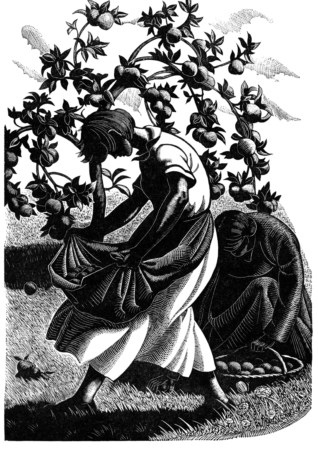
Clare Leighton is remembered as one of the finest wood engravers of the twentieth century. Having made her name with The Farmer’s Year (published in 1933), the publication of Four Hedges in 1935 established her as an engraver as well as a writer. Her skill as a chronicler of nature, the seasons, and of place (the half acre in the Buckinghamshire Chilterns that she and her partner, the radical journalist Noel Brailsford, transformed into a garden in the early 1930s) is on full display in this luminous work structured around the twelve months of the year. By observing the seasonal changes in their garden she grew familiar with its wildlife and character, forming a bond that fed her work as an artist. The book is illustrated with over eighty of her wood engravings, each one a microcosm of the landscape that encompasses them. Together, prose and engravings combine to give a sense of an earth that is full of wonder and joy.


Louise Kenward

Louise Kenward

Writer, Artist, Psychologist
PhD Candidate, Centre for Place Writing, Manchester Metropolitan University

lmkenward@icloud.com

https://footnotepress.com/books/moving-mountains/

Louise Kenward is a writer, psychologist, and artist living in East Sussex with post-viral illness. She is currently a PhD candidate with the Centre for Place Writing at Manchester Metropolitan University. Her thesis is investigating the south coast of the Romney Marshes. As one of the most at risk areas in the UK for flooding, this stretch of shore takes Louise on 12 beach walks from Pett in East Sussex to Hythe in Kent, making monthly trips to beachcomb. Objects collected and observations made inform her writing practice, holding a lens of environmental and disability justice. This practice-based thesis is informed by the flotsam and jetsam that washes up, connecting place with person in the wider context of rising sea levels and post-viral illness.

She edited a first of its kind anthology, published in 2023 by Footnote, Moving Mountains: Writing Nature Through Illness and Disability. Moving Mountains includes work by writers Kerri Andrews, Polly Atkin, Sally Huband, Khairani Barokka, Eli Clare, Kate Davis, Hannah Hodgson, Louisa Adjoa Parker and Alec Finlay. It is a collection of 26 poems, essays, and prose exploring the small to the vast and is due out in paperback on 6th March 2025.

Louise was selected in the top 10 for Media and Publishing, in the 2023/2024 Disability Power 100. She is currently working on her first full length manuscript, A Trail of Breadcrumbs: a personal history of convalescence, a journey around the world accompanied by nineteenth century women travellers.

Will May

Will May

Will May

Associate Professor in English, University of Southampton

My research explores how writing practices can inform our understanding of place. In the Leverhulme-funded project StoryPlaces, I worked with creative writers and colleagues in Electronics and Computer Science on a location-based authoring tool, running writing projects in Crystal Palace, Southampton Docks, and the Bournemouth Natural Science Society. In my teaching, I encourage students to read and write poetry in specific spaces, from secondary classrooms (‘Creative Writing in Schools), to city farms (‘Animal Forms: Poetry and the Non-Human’), to abandoned military hospitals (‘Writing Place’).

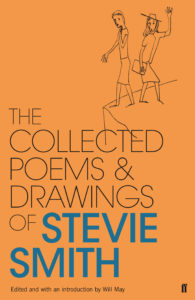
As a poetry editor and critic, I am drawn to poets who attend to the particular squelch of the earth beneath them, from Stevie Smith, the poet of flat coastlands and rainy suburban parks, to F.T. Prince, the South-African born poet whose works take in urban graffiti in Rome, Keatsian walking country, and the vast expanses of the veldt.

Publications include Stevie Smith and Authorship (OUP, 2010), The Collected Poems and Drawings of Stevie Smith (Faber, 2015), and Reading F.T. Prince (LUP, 2017).

My new project explores the places and practices of mentoring in modern British poetry, from the university seminar room to the local park bench.

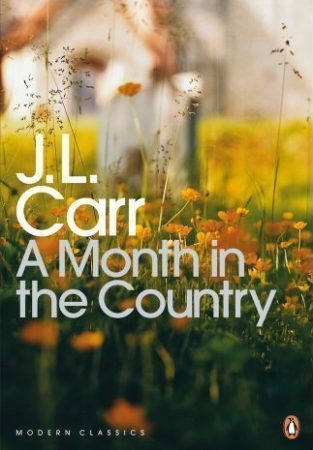
A Month in the Country

Hermione Lee reflects on the particular qualities and settings of J.L. Carr’s classic novel
 

“No book evokes so well as this the long vistas of that high ridge of North Yorkshire between Thirsk and Sutton Bank”


Joseph Lloyd Carr (1912-1994), better known as Jim, was a writer of laconic English humour, quiet precision, deep moral feeling, close knowledge of landscapes, buildings and history, and an interest in the heroism of obscure, unsuccessful, unprivileged people. Between 1963 and 1992 he wrote eight short novels. He was also a teacher and headmaster, a writer for children, an antiquarian, and an idiosyncratic publisher of pocket books, under the sign of the Quince Tree Press. His friend and admirer Penelope Fitzgerald said of him: “Carr is by no means a lavish writer, but he has the magic touch to re-enter the imagined past”.

His masterpiece, A Month in the Country, won the Guardian Fiction Prize in 1980, was short-listed for the Booker and was made into a film. Carr, an obstinate man, didn’t care that it was already Turgenev’s title – besides, the novella has a Turgenevian mood to it. It’s a story full of sadness and nostalgia, told by a shell-shocked war-veteran, Tom Birkin. In the “marvellous summer” of 1920, he has come, a wrecked survivor, with no money and a failed marriage, to a remote Yorkshire village, in order to uncover a huge medieval Day of Judgement painting on the wall of the village church, the work of an unknown medieval artist who increasingly infiltrates his mind. Down below, another war-veteran with a secret history, Mr Moon, is excavating a 14th century grave outside the church. They are “two of a kind”, both quietly dedicated to their specialised work, and both beneficiaries of the late old lady of the decaying manor-house, whose shrewd eye still seems to be overlooking their work. An obstructive, stiff-necked vicar, his fragile, beautiful wife, and the friendly, level-headed Yorkshire villagers (source of Carr’s typical humane, low-key comedy), become Birkin’s whole world that summer. 

It is a war-novel set in peace-time, full of the horror and unspeakable fear of war-memories, which can’t be spoken about. It’s a love story of great poignancy about a missed chance, and it’s a memory of an irrecoverable past, of “blue remembered hills” that can’t be found again. “If I’d stayed there”, the sad narrator asks himself, “would I always have been happy? No, I suppose not. People move away, grow older, die, and the bright belief that there will be another marvellous thing around each corner fades.  It is now or never, we must snatch at happiness as it flies”.

Above all, the novel is filled to the brim with a particular English place and time. Carr said he drew the village and its setting from his childhood in the North Riding, the church from Northamptonshire (where he spent most of his adult life), the churchyard from Norfolk and the vicarage from London: “All’s grist that comes to the mill”. Oxgodby, the name of the village, certainly echoes “Osgodby”, a village near where he went to school. And the novel brings us a vanished English country life in deep sunshine – haymaking, sleeping outdoors, Sunday School, rabbit pies, scythes, “ditches and roadside deep in grass, poppies, cuckoo pint, trees heavy with leaf, orchards bulging over hedge briars”. No book evokes so well as this the long vistas of that high ridge of North Yorkshire between Thirsk and Sutton Bank. “Day after day, mist rose from the meadow as the sky lightened and hedges, barns and woods took shape until, at last, the long curving back of the hills lifted away from the Plain. It was a sort of stage-magic – “Now you don’t see; indeed, there is nothing to see. Now look!” Day after day it was like that….”  “As it lightened, a vast and magnificent landscape unfolded. I turned away; it was immensely satisfying.”  


Hermione Lee was president of Wolfson College, Oxford from 2008 to 2017 and founding director of the Oxford Centre for Life Writing. Her books include Edith Wharton (2006), Penelope Fitzgerald (2013), and Tom Stoppard (2020). 


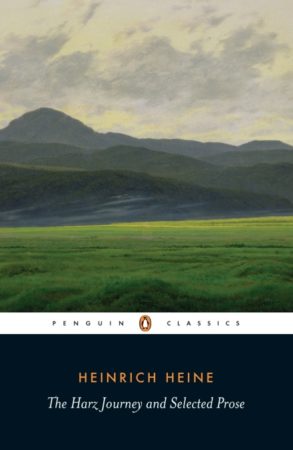
The Harz Journey

Heinrich Heine (1826)

Recommended by Andrew Hodgson

Die Harzreise is an account of a trip from the German town of Göttingen (‘famous for its sausages and university’) into the Harz mountains. You couldn’t want a more entertaining travel companion than Heine, whose voice is by turns sarcastic and lyrical, sentimental and ironic, curious and bored. Along the way are encounters with grotesque tourists, records of hallucinatory dreams, a descent into a coal mine, poems and songs in celebration of the quiet life, an ascent of the Brocken, and passages of unaffected pleasure in nature. The book ends, in a moment typical of its witty self-awareness, with Heine ‘lost in thought’ on top of a rock in the Ilse Valley, almost tumbling into a ravine under the influence of his own giddy delight in the surroundings.

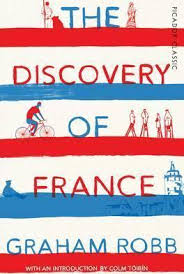
The Discovery of France

Graham Robb (Picador, 2008)

Recommended by Andrew Hodgson 

Robb offers a magnificent description of France as a massive patchwork of places. The ‘discovery’ is both the author’s uncovering of the intricate jumble of tribes, tongues, and traditions that make up France’s history, and the country’s attempt to forge a unified identity from them. The book is written with an ironic care for the way the spirit of place shapes and finds expression in the everyday existence of its people. One of the most attractive passages involves Robb pausing over the ‘large and luckless’ contingent of ordinary lives strung out among the nation’s gradual incline to modernity, who spent the best part of their years ‘cocooned in idleness’ from the gloom and cold of winter, attempting to make life as uncomplicated as possible.

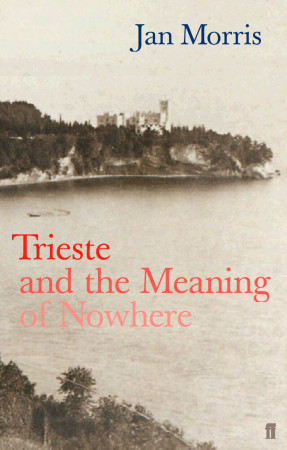
Trieste and the Meaning of Nowhere

Jan Morris

(Faber, 2002)

Recommended by Andrew Hodgson

Jan Morris’s book on Trieste is a lyrical history of the city. It is a description of Trieste and its past; it is also an attempt to work out what Trieste means to Morris, and to understand how one’s relationship with a place changes through time. It shows how to appreciate a place’s sadness, ‘the allure of lost consequence and fading power’. It’s a great book on place because it doesn’t just tell you about a place, but shows you how to enjoy it. The best place to read it is outside a bar off the Piazza Unità d’Italia, sipping a Campari and soda, gazing out into the Adriatic for a glimpse of the ghost of Browning’s Waring.

A World on the Table: Still Life Paintings and their Global Stories

Monday Conversation, 30 November 2020, with Lauren Working and Lucy Powell.

Jan Davidsz de Heem, Still Life with Parrot, c. 1655, Creative Commons.

Still life paintings from the seventeenth century present sumptuous arrangements of fruit, flowers, vegetables, silverware, and often animals or birds as well. They may be ‘still’, displayed for our visual enjoyment, but the subjects have been gathered from around the world. These pictures tell stories of travel, colonialism, displacement, power, and desire.

Our two speakers took us on an imaginative transcultural journey, bringing questions of locality, placelessness, and globalism to bear on scenes of feasting and beauty.


“We get tulips with pumpkins, maize with English strawberries, peonies with chillies…”

Lauren Working (Postdoctoral Fellow on the TIDE project, University of Oxford) gave a dazzling visual tour of the genre’s excesses and extremes, pausing in the queasy hinterlands between plenty and too much. Bringing an historian’s expertise to paintings by Dutch and English artists, she explored the tastes, networks, and trade routes, the invisible maps and webs of connection, that lie behind the shining objects assembled before us.

Lucy Powell (Leverhulme Postdoctoral Fellow, University of Oxford) looked closely at paintings of exotic birds by Jakob Bogdani, showing how closely they relate to still life and how much they have to tell us about cultures of collecting and displaying species brought to Britain from across the globe.

Our short clips will give you a taste, and a recording of the whole session is available below.

Mr Roscoe’s Garden

Jyll Bradley (Liverpool University Press, 2008)

Recommended by Martin Stott

I came to this book as a photographer. But it is much more than a photo book.  Published as part of Liverpool’s Capital of Culture celebration in 2008 it is a book about a place, Mr Roscoe’s garden in Liverpool, that no longer exists. Through words and pictures Bradley recreates the garden, and charts its life and afterlife, from its foundation in 1802 through its time as a public Botanic Garden from the 1840s to its eventual destruction in 1984 when it closed, the victim of a political storm that mirrored the cataclysmic decline of Liverpool itself. Told through the eyes of a skilled photographer, and the words and memories of Liverpool’s gardening community, the ‘garden’ almost defies definition: does its specialness lie in the plants, the gardeners, the sites, or the greatest orchid collection ever amassed in municipal Britain and rediscovered intact despite the vicissitudes of time? Drawing on history, memory, politics and place, it is a book about why we need gardens and what gardens mean.