Art of the Marsh

By Louise Kenward
Louise Kenward asks how chronic illness shapes her perception of the changing shoreline.
Beachcombing the strandline, I’ve mostly been walking in windy drizzly conditions, along the shore of the Romney Marshes at high tide. It is only in going back to Pett for low tide on a sunnier, drier day, cup of tea from the van off the slipway in hand, that I take a seat on one of the benches to pause a while. It’s a solid wooden bench, with some age but wearing well. There are dozens along here, all pointing out to sea. A dotted line of memories to loved ones, they edge the coast. I accept the silent invitation of this one and sit to look out across the water, enjoying the warmth of the sun. I wonder how much the shoreline has shifted since I was here last; with each tide of moving shingle the beach redraws itself. Over time, land bridges have formed and eroded. Pett, as with much of this stretch of coast, has been both land and water. It’s one of the things that draws me to this place – the possibility of both. This duality gives me space to be both too, solid and fluid, sick and well – the in-betweenness of Susan Sontag’s kingdoms. I am learning to live with fluctuating chronic illness, and the sea has helped me do this. Living in a body resistant to consistency often leaves me floundering on land. Marshes and inter-tidal zones offer me kinship; I feel a greater sense of belonging in these typically difficult places to inhabit. Living with a continuity of unwellness, without treatment or a finite timeline, this is a habitat that reflects those of us used to living with the unpredictable and unstable.
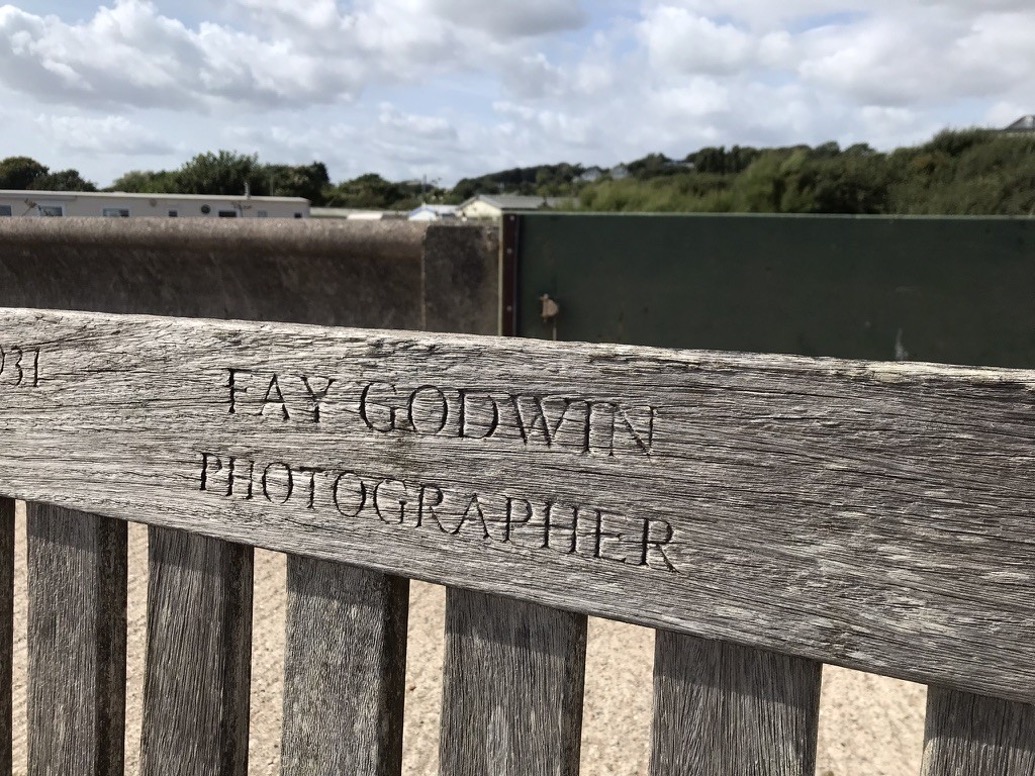
As I drain my cup and get up to walk on, I turn and notice the bench I’ve been sitting on. Its slats are weathered, letters carved into the wood, silvery and worn, with yellow lichens blooming at the crevices of the armrests. All these benches have a memorial to someone, short stories of people and place. A dedication to the places they loved, places their loved one’s loved, places filled with memories of people no longer here. On this bench, the inscription simply reads:
1931 Fay Godwin 2005
Photographer
I knew Fay Godwin Hon FRPS (1931-2005) had lived locally, she’s often listed as having been a resident of nearby Hastings. She lived at Pett Level in the latter years of her life. I know her work as a photographer documenting the Romney Marshes. I have a book of some of those images, text by Richard Ingrams, called The Romney Marsh and Royal Military Canal – the body of water that defines the inland edge of the marshes. To have sat on her bench, of all the ones to choose from, seems especially serendipitous.
I am interested in Fay Godwin as much for her experience of ill-health as for her photography. I am curious about how illness can affect writers and artists, beyond the immediacy of our bodies and levels of functioning. I’m wondering about how it impacts on creative process and practice.
My own writing practice stems from those early years of post-viral illness, once able to do more than simply keep my body alive. With a background in the visual arts, writing more readily lent itself to someone unable to leave their bed or home. My arts practice had been more physical, creating large installations, working with and responding to particular places, often overlooked or derelict. Even putting work in gallery exhibitions demanded travel for printing and submission, requiring a level of energy I no longer had. As my conditions fluctuate my creative process adapts. Using beachcombing as my current practice I can take my time, walk as far or as near as I’m able, stopping along the way. Alongside writing about the objects I collect, I have begun to develop my art practice again, returning to my camera, recording short fragments of moving image and teaching myself lenseless photography.
Godwin’s career as a photographer began in her 30s, taking pictures of her young children. She went on to take pictures of other people’s families before teaching herself how to develop and print the images she took, growing her practice into a profession. Working with publishers, she began to photograph writers and poets: Doris Lessing, Ted Hughes, Phillip Larkin, Salman Rushdie. Her portraiture evolved into a practice of social commentary, with a series of images of factory workers, people working in the fishing and oil industries, and people who were unemployed.
In her 40s, in 1976, Godwin was diagnosed with cancer and her practice changed from portraiture to landscape photography. Having recovered following conventional medical treatments, Godwin wanted to spend more time in the outdoors for her health. Convalescence is typically a term we associate with the Victorian age, often associated with being outdoors and by the sea. Living with chronic illness I know the importance for my own body of prolonged rest beyond and alongside any initial treatment and recovery. It feels as though this departure from usual routines was a way of Godwin finding the space for rest and recuperation following the cancer treatment too.
She began to walk as part of her photography practice, and went on to collaborate with several writers in creating books akin to the Wainwright walking guides[i]. The book on the Romney Marshes is one of those. In her interview for The South Bank Show in 1986 she said: ‘After being ill, I think that I concentrated more on landscape…the natural world became even more important and valuable to me, it already was, but it was even more so and I had this instinct that it would pull me through’ (The South Bank Show, 1986).[ii] I similarly experienced a greater connection to the natural world during and following severe illness. This isn’t a ‘nature cure’ as some might call it. Rather, I see it as a companionship, an identification with fellow kin. We are all a part of nature, prone to cycles of decay and growth as any other living creature, and it is perhaps a greater recognition of this that illness can foster.
Godwin’s landscape images are inseparable from her movement through place, created while walking through the countryside. An environmentalist and politically engaged thinker she was also an advocate of the Right to Roam movement and president of the Ramblers Association (1987-1990). She campaigned to protect the natural world she photographed and sought to reflect the history of the human in the landscape. The Romney Marshes embody the intervention and occupation of this place. This is no wilderness or natural beauty; it is entirely dependent on human engineering. While the shape of the coastline has altered over the centuries due to storms and longshore drift, the reclaimed land has subsequently been maintained with constant and ongoing management. Shingle is regularly transported west, from Rye Harbour to Pett, from one side of Dungeness power station to the other – protecting the coast from continuing to travel eastwards. The ditches and sewers networked throughout the marshes are perpetually draining and moving water. Early inhabitation was organised around precisely this. Walls were built and dykes dug, each resident responsible for their own stretch – to clear, maintain and rebuild when necessary. This is written in the early records, the foundation of the Romney Marshes centres on maintaining the land as land, protecting it from the encroaching sea. Without it, with much of the land below sea level, this would quickly be drowned again by the tides.
Godwin’s black and white landscape photography took her across the UK, along with trips to Hawaii and New Zealand for photography workshops. Often associated with light, Godwin’s photography was also about time. Taking photographic images was a durational process, one that demanded patience and attunement to her surroundings. ‘I don’t get wrapped up in technique and the like’ she said in one interview about her process. ‘I have a simple rule and that is to spend as much time in the location as possible. You can’t expect to take a definitive image in half an hour. It takes days, often years…The land is a living, breathing thing and light changes its character every second of every day. That’s why I love it so much.’ The work also references time through the inclusion of human presence, of buildings and artifacts.
For me, as with others who live with perpetual illness, time has an altered value. I can no longer fall into the patterns of human created time, of 9 to 5 and normative linear time. My body requires its own pace and time keeping. It can be cyclical, repetitive; time jumps and slows. Ellen Samuels wrote about this as ‘crip time’[iii]. Crip time is waiting time, for appointments and access requirements causing people to be late for things. It can be extra time I need to get up in the morning, for my body to adjust to being awake and upright. Additional time is needed throughout the day, to listen and attune to the needs of my body. In the words of Alison Kafer: “rather than bend(ing) disabled bodies and minds to meet the clock, crip time bends the clock to meet disabled bodies and minds.”[iv] I see the tides running to crip time, moving no faster nor more slowly than they will, governed by the moon not man.
Like Godwin, I have noticed my own creative practice develop in response to my changing physical health. Instead of being able to spend prolonged periods of time in one place, or to walk the entire coastline, I move slowly, walking short distances, and return time and again. It is with repetition that I learn more about a place. The ritual of beachcombing focuses my attention to one specific part of the coast. I study the strandline looking for clues of what is happening elsewhere, of the things I don’t or can’t see. The strandline shows me fragments of life beneath the water in the shells and egg cases. It shows me the presence of people and the fishing industry through washed up plastic and string.
While Godwin initially responded to treatment and recovered from cancer, it seems it returned some years later. As many people experience, it is not just the illness that causes the most immediate problems; the treatments can be as debilitating as the illness itself. Unable to walk as she had previously enjoyed, her practice changed again. This time, Godwin blamed the medication she had been given for her disability. It affected her heart, impacting negatively on her energy levels and stamina[v].
Energy limitations and lack of stamina are some of the most prolific symptoms for anyone living with disability and/or chronic illness[vi]. Yet they are often least recognised, poorly understood, without effective treatment and difficult to quantify. These are also often one of the most impactful experiences, with little in the way of adaptations available, as there might be with other forms of disability, undermining every element of day-to-day functioning. Otherwise daily activities of washing and eating can become momentous tasks, rendering a person unable to do much else in their day and requiring rest to recover from.
In response to this second prolonged period of illness, Godwin began to work on abstract images and macro photography. Some of Godwin’s last works are collected into a book called Glassworks and Secret Lives (Godwin, 1998). Many of the images were large prints included in her last retrospective at the Barbican Gallery, London, in 2001. The book is a collection of abstract views of the landscape, a departure from both her early portraiture and the wide-open expanses of places previously documented. In his introductory essay to the book, photography critic Ian Jeffrey references the absence of the horizon and how disorientating this is for a viewer. He writes: “To remove the horizon, then, entails a return to the pre-rational, or at least to a time before our powers of abstraction made it possible to think about as well as to sense place.” Removing the horizon “remove(s) assurances that that the earth is fully amenable to human order.” (Jeffrey, 1998 p8).
A horizon offers the viewer an anchor point. It provides information about where you are in space, which way is up, a distinction between land and sky. Without it, suggests Jeffrey, the viewer can feel unmoored. When out at sea and in motion our bodies can respond in a very visceral way to this through seasickness. To manage these experiences, we are told to concentrate on the horizon. The horizon steadies our bodyminds in very real ways. For those who develop chronic ill-health, disabled by energy limitations, we are more used to an absence of a metaphorical horizon. It is more easily recognised that there are no such assurances of Jeffrey’s ‘human order’ in the world, ours are upended and there is little solid ground to rely on by way of medical treatments or societal understanding and support. In perpetual illness the horizon moves and slides or is erased entirely. I disagree with Jeffrey’s statement though: I can think about and sense place without it. It is simply a different way of sensing and thinking than it might be for others.
What we develop in the absence of a stable horizon is, I think, the richness and creativity that can come with living with and having to adapt to experiences of chronic illness. We learn, perhaps, to redraw a horizon, to watch for it even when it is moving. For those who are limited to movement within their home or their bed, the horizon outside may very literally be obscured. When I was first seriously ill fourteen years ago, largely confined to my bed for nearly a year, I was living in a basement flat near the sea – just along the coast from Pett in Bexhill. At the front of the building, beyond the window, my horizon was the pavement where I’d see people passing from the knees down. I felt literally and metaphorically subterranean. I could still track a sense of time, through changing light and shadows, weather and the clothes people wore, and my sense of place remained, albeit much smaller, through my memory and knowledge of what lay beyond my street.
Jeffrey quotes Pythagoras in Ovid’s Metamorphoses: “Our bodies too are always, endlessly changing; what we have been, or are today, we shall not be tomorrow.” (Jeffrey, 1998 p7). While Godwin’s health and diagnosis is never mentioned by her or Jeffrey, the implication is embedded throughout. At the end of his essay Jeffrey returns to Ovid, citing Metamorphoses, xv: “Nothing retains its form; new shapes from old Nature, the great inventor, ceaselessly contrives. In all creation, be assured there is no death – no death, but only change and innovation…” (Jeffrey, 1998 p12).
One of society’s great collective denials is of disability and chronic illness. It is the one marginalised group we are all likely to join at one time or another during our lives. To accept this and build a world that is more tolerant, accepting and supportive of sick and disabled people would make for an easier place to live in for us all. It can be life changing to become sick and not recover, to acquire a disability through illness, trauma or accident. The grief associated is amplified by the inaccessible and unforgiving society we live in, one which celebrates physical achievements and productivity rather than our humanity.
Jeffrey goes on to write of Godwin’s images: “Animated nature acts in memory of the body’s organs and surfaces: lungs and the tracks of nerves.” (Jeffrey, 1998). My own work is attempting to integrate the natural world with the body, and vice versa, slipping from human to more-than-human and back again. I am drawing on metaphor and the imagination in my writing. Each of Godwin’s prints in Glassworks and Secret Lives are untitled, but grouped into named series within the collection. Many of the images show partial plant matter in close-up views, spider webs, shadows, rocks and condensation. All are taken in colour and at very close range. Page 46 of the book shows one image from the series Lings’ Secret Lives, 1993/4. This picture is predominantly red in colour, with branching veins from a central stem. The dominant object looks as though it could be pulsing and breathing, recently removed from or observed within the body.
I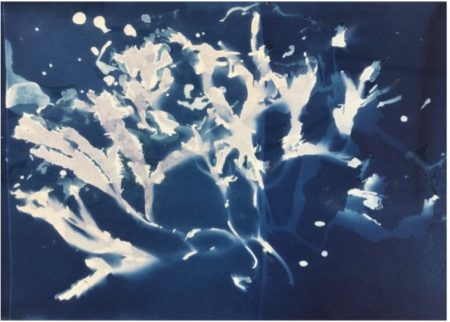 n the notes at the end of the book Godwin writes about the process of making the work. Borne out of chance, she had begun to ‘explore the detail, forgotten corners, behind glass, plastic and other materials’ after being given some colour film (Godwin, 1998 p53). It began in Sussex at a nursery that had held a special kind of magic for her, in 1989. She goes on to comment on how, despite initial appearances, there is a clear connection with her black and white landscape images, the thread between both sets of work being the role of the human in the landscape, of the use and history of the land.
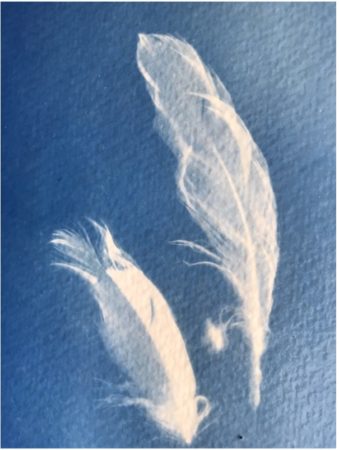
Retuning to a process of visual art I am teaching myself lenseless photography techniques. Beginning with cyanotypes, I spent a week in a caravan further along the coast in Greatstone last spring. Using the shower room as a dark room, I painted sheets of watercolour paper with the chemical solution and collected objects from the beach to expose under a sheet of glass on the deck area outside. In the bright sunlight I was lucky enough to have, they quickly transformed into indigo prints. Perhaps these draw on a similar creative response to the one Godwin was motivated by in her close-up colour work. They are small, curated abstracts, more manageable for my energy levels than long hikes across the marshland. It is as if the place making work about itself, something I am hoping to develop, drawing on elements of the Romney Marshes and the intertidal zone.
This unstable coastline, prone to shifting and sliding, reminds me of the vagaries of chronic illness, a place of anomalies and contradictions. The ebbing and flooding of the tide and the betweenness of its intertidal zone connects me to this uncertain body I live in. Connecting with Fay Godwin, and others who adapt their creative practice through illness, connects me to place and people in new ways: of making sense, of understanding, and of exploring the world we live in.
References:
Jeffrey, I. (1998) Introductory essay in Glassworks and Secret Lives. (Godwin, 1998) Rye: Stella Press.
Fowles, J. (1985) Essay in Land. (Godwin & Fowles, 1985) London: Cornerstone.
Godwin, F. & Fowles, J. (1985) Land. London: Cornerstone.
Godwin, F. (1998) Glassworks and Secret Lives. Rye: Stella Press.
Kafer, A. (2013) Feminist Queer Crip. Bloomington: Indiana Press.
Samuels, E. (2017) “Six Ways of Looking at Crip Time”, Disability Studies Quarterly 37(3).
The South Bank Show (1986) London Weekend Television (LWT). 9th November.
O’Neill, B. (2023) Exploring the Fay Godwin Archive at the British Library. The Royal Photographic Society. Online: https://www.youtube.com/watch?v=abRv6mt-pVQ (accessed 2nd January, 2026).
The South Bank Show: Fay Godwin (1986) London Weekend Television (LWT). 9th November. online: https://www.youtube.com/watch?v=4JE8I44Ak7o (accessed 2nd January 2026).
Samuels, E., (2017) “Six Ways of Looking at Crip Time”, Disability Studies Quarterly 37(3). doi: https://doi.org/10.18061/dsq.v37i3.5824 (accessed 2nd January 2026)
Kafer, Alison. (2013) Feminist Queer Crip. Bloomington: Indiana University Press.
Corfield, D. (2005) No Man’s Land – Fay Gowin’s Last Interview. ePHOTOzine. 31st May. https://www.ephotozine.com/article/no-man-s-land—fay-godwin-s-last-interview-67
Hale, C. Benstead, S. Lyus, J. Odell, E. & Ruddock, A. (2020) Energy Impairment and Disability Inclusion: Towards and Advocacy Movement for Energy Limiting Chronic Illness. Centre for Welfare Reform. https://chronicillnessinclusion.org.uk/wp-content/uploads/2021/04/energy-impairment-and-disability-inclusion.pdf
Images:
Cyanotypes made at Greatstone during a residency Louise Kenward
Photographs of the bench at Pett, dedicated to Fay Godwin, by Louise Kenward
[i] O’Neill, B. (2023) Exploring the Fay Godwin Archive at the British Library. The Royal Photographic Society. Online: https://www.youtube.com/watch?v=abRv6mt-pVQ (accessed 2nd January, 2026)
[ii] The South Bank Show: Fay Godwin (1986) London Weekend Television (LWT). 9th November. online: https://www.youtube.com/watch?v=4JE8I44Ak7o (accessed 2nd January 2026).
[iii] Samuels, E., (2017) “Six Ways of Looking at Crip Time”, Disability Studies Quarterly 37(3). doi: https://doi.org/10.18061/dsq.v37i3.5824 (accessed 2nd January 2026)
[iv] Kafer, Alison. (2013) Feminist Queer Crip. Bloomington: Indiana University Press.
[v] Corfield, D. (2005) No Man’s Land – Fay Gowin’s Last Interview. ePHOTOzine. 31st May. https://www.ephotozine.com/article/no-man-s-land—fay-godwin-s-last-interview-67
[vi] Hale, C. Benstead, S. Lyus, J. Odell, E. & Ruddock, A. (2020) Energy Impairment and Disability Inclusion: Towards and Advocacy Movement for Energy Limiting Chronic Illness. Centre for Welfare Reform. https://chronicillnessinclusion.org.uk/wp-content/uploads/2021/04/energy-impairment-and-disability-inclusion.pdf